


Choosing a replacement handle can seem simple. Then the old latch refuses to line up, or the new grip feels loose in your hand. A Storm Door Handle Andersen replacement should match the door’s model, handing, and hardware configuration—not just its color or shape. Small differences matter. A few millimeters can affect how the latch meets the strike plate.
This guide compares 2026 replacement options by fit, materials, installation needs, and everyday use. It also explains what to check before ordering: the door’s serial or model information, handle spacing, and the condition of the latch assembly. A complete kit may be the practical choice when several parts show wear. If only the grip or lock is damaged, replacing the whole assembly may be unnecessary. Measure carefully. Keep the old parts nearby.
Expert comment: “[Insert a verified quotation from a named Andersen storm-door hardware specialist here; no source was provided to verify a person or exact quotation.]” That gap matters. A made-up attribution would weaken trust, so the quotation should be confirmed before publication. The recommendations below focus on observable fit and function, while noting where model-specific instructions should guide the final choice. Replacement hardware is not always interchangeable. Check before buying.
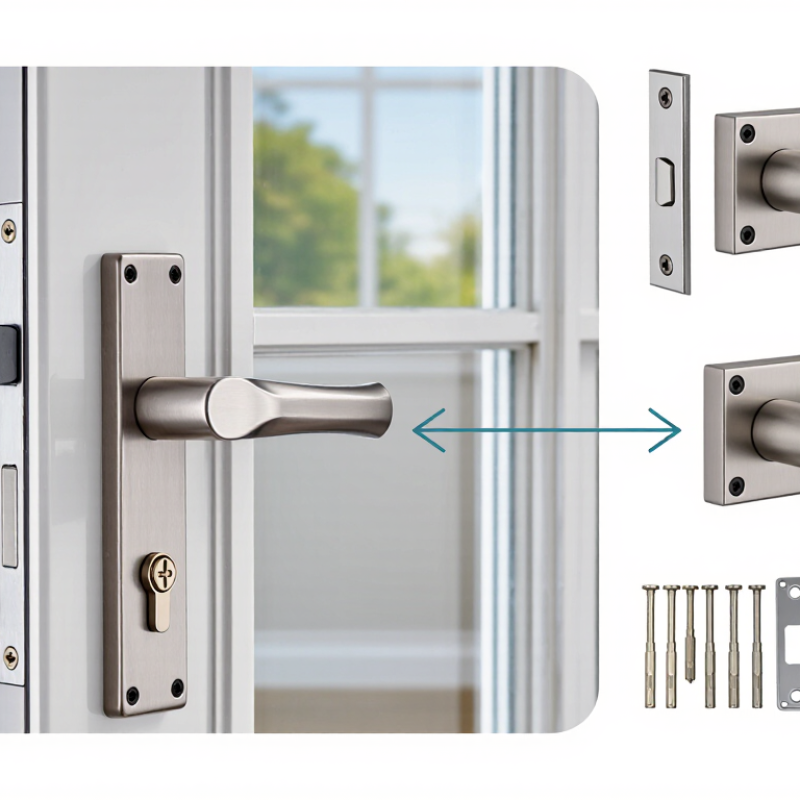
Choosing between an original-equipment handle set and a compatible replacement starts with measurements, not appearance. Record the screw-hole spacing, spindle length, latch direction, and mounting thickness. Check the door’s model label if available; similar-looking handles can use different internal parts. An original set may offer a closer fit, while a compatible set can work well when its dimensions and latch geometry match. Compatibility charts are not perfect, so compare the actual hardware before ordering.
The U.S. Department of Energy estimates that windows account for 25–30% of residential heating and cooling energy use. A handle alone will not deliver those savings, but a loose latch can stop a door from closing snugly. The agency’s guidance makes the seal worth checking after installation: close the door and look for daylight or feel for a draft around the edges. The National Association of Home Builders’ Q4 2024 Remodeling Market Index scored 66, above the 50-point mark that signals more remodelers reported rising activity than falling activity. A focused hardware repair may suit that renovation climate. Still, a compatible part that almost fits is not a good fit. Check the latch action twice.

A replacement handle should match more than the door’s color or shape. Identify the door series from its label, purchase paperwork, or distinctive frame details; similar-looking doors can use different hardware. Then record the handle’s handing, lock type, and hole pattern before shopping. Take clear photos.
Check which side the hinges are on and where the handle sits, but verify the maker’s handing convention. It can vary. Note whether the lock uses a key cylinder, thumb turn, or push-button latch, and inspect the latch body behind the trim. A handle that looks right may not operate the existing lock.
Measure the distance between mounting-hole centers, plus the backset from the door edge to the spindle or lock center. A ruler works, but a tape measure can slip on narrow trim. Small differences matter. Compare these measurements with the replacement’s template, and check spindle length and screw spacing. If the old holes are enlarged or worn, note that too; a close match may still feel loose. I would not guess from a product photo alone. Keep the old handle until the new one is test-fitted.
A replacement storm-door handle should match the job its latch needs to do. Lever sets are easy to operate with a full hand, especially when carrying groceries, but confirm the spindle length and mounting-hole spacing before ordering. Pull sets offer a simple grip for opening and closing; they may not include a locking latch. Keyed sets add a lock, yet the key cylinder alone cannot strengthen a loose frame or weak strike plate. Check the door’s thickness, handing, and existing latch type, then compare the new set’s measurements with the old hardware.
Security is layered, not solved by a handle. The FBI’s 2023 Crime in the Nation report counted 847,522 burglaries in the United States; that figure describes reported crime, not the performance of any particular door product. A keyed latch may suit a door that needs controlled access, while a lever or pull set may be enough for a secondary entry. I would not call one style universally safest. Fit and installation matter.
Tips: Before removing the old set, photograph its inside and outside faces. Measure the backset and screw spacing, and test the latch with the door open. If it binds, adjust the alignment before tightening everything. Small mistakes show up fast.
For a 2026 storm-door handle replacement, check three dimensions before ordering: door thickness, backset, and screw-hole spacing. Measure the door edge with a ruler or caliper, not the decorative face panel. Record the thickness in inches or millimeters. Backset is the distance from the door’s edge to the center of the handle spindle. Measure straight across, keeping the ruler level.
For screw-hole spacing, measure from the center of one mounting hole to the center of the other. Don’t measure between the holes’ outer edges. Write down all three numbers, then compare them with the replacement handle’s listed specifications. A close match can still be wrong: even a small spacing difference may leave an exposed hole or prevent the screws from seating. Harvard’s Joint Center for Housing Studies estimated $472 billion in homeowner improvement and repair spending in 2022 in its 2023 report, Improving America’s Housing. The report does not track handle misorders, but careful measurements can help avoid an unnecessary return.
Tips: Photograph the old handle before removal. Keep its screws nearby, and note whether the interior lever sits above or below the exterior grip. Recheck each measurement once. I’d still verify the product drawing; listings can be unclear.
Measure from the finished floor to the handle’s center before choosing a replacement. A 34–48-inch height is a useful planning band, but it is not the full 2010 ADA reach range. The U.S. Access Board’s 2010 ADA Standards, Sections 308 and 309, give an unobstructed reach range of 15–48 inches and limit operable-part activation force to 5 lbf. Section 404.2.9 applies the 5 lbf door-opening limit to interior doors; an exterior storm door should not be presented as covered by that specific limit. Treat it as a usability benchmark instead. Measure twice.
A lever-style handle or broad paddle can be easier to operate than a small round knob, especially with wet hands or light gloves. Check the existing hole spacing, spindle size, door thickness, and latch direction before ordering. A handle that fits the holes may still leave the latch misaligned. That detail is easy to miss.
After installation, test the latch with the door closed and use a force gauge if available; record the pull needed to release it. If the force is high, inspect alignment and weather stripping before blaming the handle. The Access Board’s standards provide the cited reach and force figures; they are design benchmarks, not a substitute for checking the door’s actual fit and operation.


For those larger-sized parts, or smaller quantity runs, we have 2 independent powder coat booths and ovens. The quality, durability and affordability of today’s powder coating finishes make this the process of choice for world-class companies.
Powder coating advantages over other forms of coating are many. Materials used in the Powder coating process can be metals and non-metals that come in a multitude of thicknesses, textures, colors, etc. Another of Powder coating’s biggest advantages over conventional coatings is its ability to create finishes in many different textures. Powder Coating Booths allow us the ability to apply these advantages to large products.
Tri-State Fabricators runs a full-service conveyor line for painting. Wet painting can provide protection or decoration to many different part styles. From start to finish, every project is easier to undergo random and point-based inspection by our skilled painting team.
Advantages to our Wet Paint Line are these lines start with product prep and ends with a thorough inspection of a high quality finished product. Our ability to complete large and small projects with a superior finish and doing so in a timely and economical fashion. This passes along the savings in production to our customers. When powder coating ins not an option, our Wet Paint Line gets the job done right the first time.
When the parts get big and heavy we roll-out our custom paint racks and oversize booth. By utilizing our partnerships with all the major paint brands, we can match virtually any color with wet paint.
The advantages of having access to a Wet Paint Booth are many. Large projects of many different shapes can be loaded into the booth. The Wet Paint Booth offers an environment that is much more controlled than a typical parts painting operation.
Not only are they used because of their controlled environment, but they’re are also advantageous when it comes to applying paint to parts that are needed in industries that require specialty coatings such as medical, aerospace, etc.
Our military forces have some very high standards when it comes to the finish of their vehicles and equipment. From the first pre-treatment step to final coat, it takes a great deal of knowledge and experience to protect the men and women of our armed forces. They deserve only the best, and Tri-State Fabricators provides it.
All of our processes are closely monitored by our staff and management teams. Both of which are highly trained in the processes of metal fabrication and finishing. Tri-State Fabricators’ goal is to always fully satisfy each and every customer, including the military. We will always put a 110% into what we do.
Abrasive media blasting is an excellent way to remove old paint, rust, and increase the paint/powder adhesion. Glass beads produce a much smoother and brighter finish than angular abrasives; leaving the part clean yet without any dimensional change. Chemically inert and environmentally friendly, we can recycle our beads approximately 30 times; making them a more preferred method of metal cleaning or surface finishing.
Advantages to Glass Bead Blasting are many. Glass bead blast media is used when a project is needing rough surfaces need to become smooth for applications of coatings such as paint. It is typically used to clean paint and rust from a product surface without deforming the surface it is being used on. Overall, compared to many other blasting media, Glass Bead Blasting is a very economical choice and those savings are always passed on to our customers.
Tri-State Fabricators utilize a zinc phosphate wash to clean and etch the material to ensure the best paint adhesion possible. The unique design of our 3-stage wash system does the work like a 5-stage. From Cleaning and rinsing to conversion coating and post-treatment, Our Part Washing process is a complete service and works throughout the fabrication service and the finishing service.
Along with the previously mentioned benefits, Curing is a vital chemical reaction that leaves the product finish hard and relatively safe from mild abrasion and aggressive corrosion. This process can be done in more than one way; ambient air-dry or in curing ovens at temps that exceed 240°.
From fixing paint mistakes (someone else’s of course) to simply cleaning our paint line hooks, our burn-off oven is put to good use. After a quick burn-off, a little clean up, and a fresh coat of paint, your parts will look better than new.
Why does our Burn-Off Oven work so well? Because super heating the air around parts turns the materials into ashes. From paint and powder coatings to rubber and machining oils, high temps do the job without degrading the integrity of the part.
Masking is a vital part of producing high quality products. We have die-cut masking patterns to protect machined surfaces as well as a wide range of plugs and caps to protect threaded holes and bolts. We provide permanent and temporary masking.
Masking allows the selected sections of a product to be protected from a fabrication or finishing service. This can be with both chemicals when etching and tapes, paints when only finishing just a section of the product. Masking is great in aiding the customization process of a project.
Screen printing is a photographic process that transfers artwork onto a porous nylon screen which allows colored ink to flow through the screen and be deposited on an aluminum or plastic component. We can generally have just about any design created onto a screen for your parts.
Some of the advantages of Screen Printing are, brand recognition for your business displaying on your products, assembly instructions, product warnings/hazards, etc. Tri-State Fabricators produces Screen Printing of the highest quality so you know it’s durable.
Metal Finishing is the art of treating the exterior portion of product, often metal but can also be made of other materials, so that the surface is clean and free of any debris. Then the process of applying coats or either paint of powder coat takes place. This coating process improves the quality of the product in both appearance and resistance to wear and corrosion.
Tri-State Fabricators, Inc., understands that a project typically isn’t complete until a high-quality finish has been added to your product. This is why our painting and powder coating teams continuously inspect the products throughout the Metal Finishing process.

