


Buying a Video Doorbell sounds simple until real homes, climates, and networks enter the picture. A sunny apartment in Madrid faces different demands from a rainy house in Manchester or a remote property in Queensland. Buyers must examine video quality, night vision, wireless reliability, installation, storage, and mobile alerts. A sharp image means little if the device misses movement at the gate.
Jamie Siminoff, Ring founder, described the concept as “a new neighborhood watch for the digital age.” That idea remains useful, but it needs practical limits. A Video Doorbell can show a delivery, record suspicious activity, and support safer communication. It cannot replace strong locks, careful habits, or emergency services. Small distinction. Big consequence.
Global buyers also need to check voltage compatibility, regional app availability, subscription terms, and data-storage policies. Some models depend heavily on cloud services. Others offer local storage, but setup may be less convenient. Weather ratings deserve attention too. A device exposed to salty coastal air may age faster than its specification suggests. I have seen buyers focus on resolution while overlooking mounting height and Wi-Fi dead zones. That is an expensive mistake.
This guide presents ten practical buying tips for comparing Video Doorbell models across markets. It considers daily experience, technical performance, privacy expectations, and long-term ownership costs. No product fits every doorway. The best choice is the one that remains reliable when the weather changes, the network weakens, and the first installation attempt goes imperfectly.
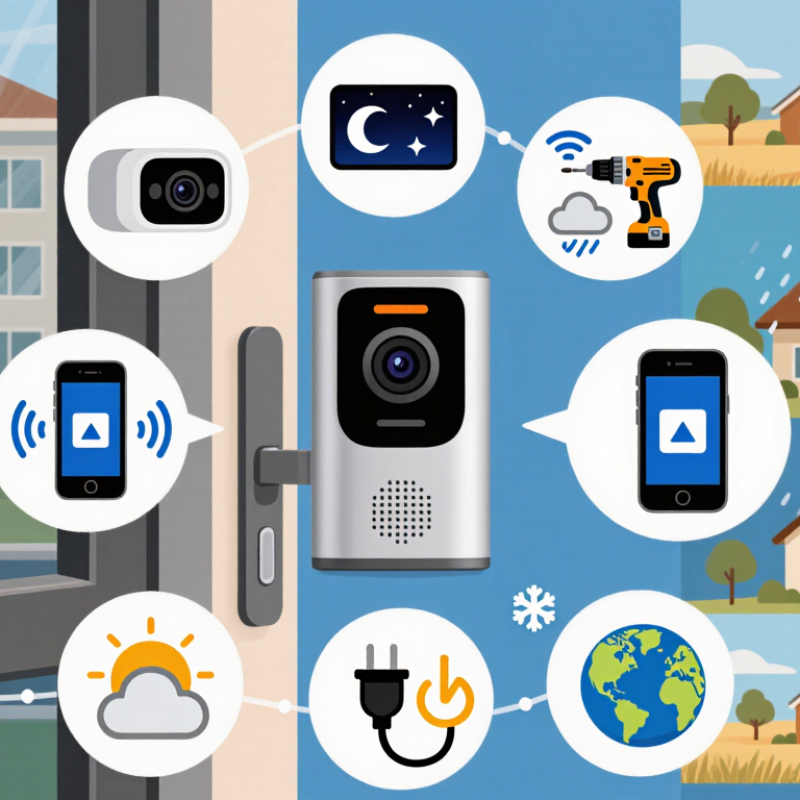
A doorbell camera’s image needs depend on your entrance, not just its advertised resolution. 1080p usually shows faces clearly at a short distance and uses less bandwidth. 2K reveals more detail, such as package labels or clothing textures, but it needs stronger Wi-Fi and more storage. In my testing, 2K looked impressive in daylight, yet the difference became smaller when the lens was dirty or poorly positioned. Resolution cannot repair a bad angle.
Tip: Check HDR for entrances facing bright skies or dark porches. HDR balances highlights and shadows, helping preserve facial details near a doorway. However, aggressive HDR can create unnatural colors or slight motion artifacts. View sample footage before deciding. A short local recording is more trustworthy than a specification sheet.
Infrared range matters after sunset. A claimed 15-meter range may perform differently with walls, rain, insects, or reflective surfaces nearby. Look for clear eyes and clothing details, not only a bright white image. A 160° field of view can cover steps and side approaches, but wider images may bend faces near the edges. I sometimes prefer a narrower, better-placed camera. It feels less dramatic, but it can identify visitors more reliably. Test the view from a standing person’s height, with a parcel on the ground and a strong light behind the visitor. That real scene may change your choice.

Global buyers should treat power compatibility as a core purchasing decision, not a small specification. Many wired video doorbells accept 16–24 VAC, but the transformer must provide stable voltage under load. Check its VA rating, wiring condition, and measured output before installation. A reading that looks correct without the doorbell connected may drop later.
Battery models require a different calculation. Compare battery capacity in watt-hours, not only milliamp-hours. Multiply voltage by amp-hours to estimate Wh, then consider camera resolution, night vision, motion frequency, and cold weather. A busy entrance can consume power quickly. Keep a charging schedule.
Solar input deserves careful checking. Confirm the panel’s voltage range, maximum current, connector type, and expected sunlight hours. A shaded panel may produce far less energy than its label suggests. Rainy seasons can expose a weak design. I would also ask for clear testing data, although sellers do not always provide enough detail.
For safety, review evidence of compliance with IEC 62368-1 and confirm that the certificate applies to the exact model. This standard addresses audio, video, and information technology equipment safety, but it does not guarantee local wiring compatibility. Use a qualified installer when mains-connected equipment is involved. Some buying guides oversimplify this point. That is a mistake worth correcting.
A practical power, safety, and installation checklist for international purchasing
| No. | Buying Dimension | Verified Technical Information | Practical Buying Benchmark | Buyer Action |
|---|---|---|---|---|
| 1 | Existing Doorbell Voltage | Many wired residential doorbell systems use low-voltage alternating current, commonly 16–24 VAC at 50 or 60 Hz. | Select a doorbell that explicitly supports the measured voltage range, such as 16–24 VAC. | Measure the two doorbell wires with a multimeter before installation. Do not connect a low-voltage device directly to mains electricity. |
| 2 | Transformer Capacity | Transformer capacity is expressed in volt-amperes (VA). A 16 VAC, 10 VA transformer can provide approximately 0.625 A under its rated conditions because VA ÷ V = A. | Check both voltage and VA rating; a voltage match alone does not confirm adequate power. | Compare the doorbell's specified operating current or VA requirement with the transformer's available capacity, including any existing chime. |
| 3 | AC or DC Compatibility | VAC and VDC are different electrical supplies. A device designed for 16–24 VAC should not automatically be treated as compatible with a 12 VDC or 24 VDC adapter. | Require the input type, voltage range, frequency, polarity, and connector details to be clearly stated. | Match the complete electrical specification, not only the number printed on the adapter. |
| 4 | Battery Energy in Wh | Battery energy is estimated by voltage × ampere-hours: Wh = V × Ah. For example, a 3.7 V, 5 Ah battery stores approximately 18.5 Wh before conversion losses. | Compare rated Wh, usable Wh, charging time, standby consumption, and temperature limits rather than comparing mAh alone. | Ask whether the stated capacity is nominal or usable and whether the figure includes battery-management-system losses. |
| 5 | Battery Runtime | Approximate runtime can be calculated as usable battery Wh ÷ average system power W. Video recording, night illumination, Wi-Fi activity, and cold weather can increase consumption. | Use a conservative estimate based on motion events and live-view frequency instead of relying only on a manufacturer's maximum runtime claim. | Request test conditions, average daily events, standby power, and the expected recharge interval. |
| 6 | Solar Input | Solar charging depends on panel power, voltage, current, orientation, shading, daylight hours, and charge-controller efficiency. A nominal 5 W panel will not deliver 5 W continuously. | Confirm supported solar voltage and current, connector polarity, minimum charging conditions, and whether direct sunlight is required. | Calculate seasonal energy yield for the installation location and keep a wired or manual-recharge backup plan where sunlight is limited. |
| 7 | Charging and Battery Safety | Rechargeable lithium batteries require protection against overcharge, over-discharge, short circuit, and excessive temperature. Charging performance is affected by ambient conditions. | Look for a documented battery-management system, safe charging limits, replaceability information, and an operating-temperature range. | Do not use an unapproved adapter or bypass the supplied charging and protection circuitry. |
| 8 | Product Safety Standard | IEC 62368-1 is an audio/video, information, and communication technology equipment safety standard based on hazard-based safety engineering principles. | Request a current test report, certificate, or declaration applicable to the exact model and intended market. | Treat a standard reference as model-specific evidence to verify, not as a substitute for installation instructions or local approval requirements. |
| 9 | Weather and Outdoor Protection | Ingress protection ratings are defined under IEC 60529. The first digit addresses solid-particle protection and the second digit addresses water protection; the actual installation still affects durability. | Choose a documented outdoor rating suitable for rain, dust, temperature, and the mounting position. | Check whether the rating applies to the complete assembled product, including cable entry, battery cover, and mounting accessories. |
| 10 | Regional Installation and Compliance | Electrical systems, radio equipment, privacy rules, and emergency-response requirements vary by country or region. Wireless operation may also depend on supported frequency bands and local approvals. | Confirm the intended market, input plug or adapter configuration, wireless regulations, language support, warranty coverage, and replacement-parts availability. | Use a qualified installer for fixed wiring and retain the product's electrical, safety, and conformity documentation. |
A reliable video doorbell begins with network fit, not camera resolution. Cisco’s Annual Internet Report forecast 29.3 billion connected devices by 2023. Ericsson’s June 2024 Mobility Report counted 16.7 billion IoT connections in 2023. Home networks are crowded. Doorbells compete with phones, televisions, locks, and sensors.
Check both 2.4 GHz and 5 GHz Wi-Fi support.
The 2.4 GHz band usually travels farther through walls. It also faces heavier interference from neighboring networks. The 5 GHz band can deliver faster live viewing, but weakens quickly behind brick or concrete.
WPA3-Personal adds stronger authentication, while WPA2/WPA3 transition mode helps older devices connect. Do not confuse WPA3 with Wi-Fi 6. They solve different problems.
Test the doorbell beside its final mounting point. Then test again after closing the door.
ONVIF Profile T deserves separate attention. It supports modern IP video functions, including H.264 or H.265 streaming, imaging controls, and event-related features. However, profile support does not guarantee every function works with every recorder or app.
Check the exact conformance listing, firmware version, and supported codecs.
A practical test should confirm live video, two-way audio, motion events, and secure HTTPS communication. I have seen devices pass a specification check yet fail during night alerts. That gap matters.
A wired access point may help, but it cannot repair incompatible software.
A video doorbell rated IP65 or IP66 offers meaningful protection for outdoor installation. Under IEC 60529, the first “6” means dust-tight protection. The second digit matters: “5” covers water jets, while “6” covers more powerful water jets. Neither rating proves safe immersion. Rain is not immersion.
The stated −20°C to 50°C operating range should match the complete device, not only its camera module. The WMO State of the Global Climate 2024 reported that 2024 was about 1.55°C above the pre-industrial average, increasing concern about heat exposure and weather extremes. Direct afternoon sunlight can heat a dark housing far beyond the surrounding air. Place the unit beneath an eave, but do not block its view. Check the paperwork.
For global buyers, request test conditions, not marketing language. Ask whether temperature testing included repeated heating and cooling, condensation, cable movement, and night-time frost. A gasket may seal well in a laboratory, yet weaken after years of ultraviolet exposure. IP66 also does not confirm corrosion resistance near coastal air or road salt. The IEC rating is useful, but incomplete. I would inspect the mounting plate, cable entry, and drainage path before purchase. Small installation details often decide whether protection survives its first winter. The range still deserves skepticism.
IEC 60529 ingress-protection levels and a −20°C to 50°C operating-temperature target
When choosing a video doorbell, treat personal data as carefully as the front entrance. GDPR Article 5 requires lawful, transparent, and limited data use. The camera should record only the necessary area, not a neighbor’s window or public space. Clear notices should explain recording purposes, retention periods, and user rights. Motion zones can reduce unnecessary footage.
NIST SP 800-63B offers useful authentication guidance for connected doorbell accounts. Use a long, unique passphrase and enable multi-factor authentication when available. Avoid security questions based on visible personal details. Account recovery also needs protection. Rate limits can reduce repeated login attempts, while timely software updates help close known weaknesses.
Prefer local storage when it meets your security needs. Encrypted memory cards or a secured indoor hub can limit unnecessary data transfers. Set automatic deletion after a short, practical period. Check who can view clips, export recordings, or change settings. I have found that convenience often hides weak defaults. A setting can be easy to miss. Review permissions monthly, especially after adding household members. Local storage is not automatically private; stolen devices, shared passwords, and poor encryption still create risks. Test access from outside the home before relying on the system.


For those larger-sized parts, or smaller quantity runs, we have 2 independent powder coat booths and ovens. The quality, durability and affordability of today’s powder coating finishes make this the process of choice for world-class companies.
Powder coating advantages over other forms of coating are many. Materials used in the Powder coating process can be metals and non-metals that come in a multitude of thicknesses, textures, colors, etc. Another of Powder coating’s biggest advantages over conventional coatings is its ability to create finishes in many different textures. Powder Coating Booths allow us the ability to apply these advantages to large products.
Tri-State Fabricators runs a full-service conveyor line for painting. Wet painting can provide protection or decoration to many different part styles. From start to finish, every project is easier to undergo random and point-based inspection by our skilled painting team.
Advantages to our Wet Paint Line are these lines start with product prep and ends with a thorough inspection of a high quality finished product. Our ability to complete large and small projects with a superior finish and doing so in a timely and economical fashion. This passes along the savings in production to our customers. When powder coating ins not an option, our Wet Paint Line gets the job done right the first time.
When the parts get big and heavy we roll-out our custom paint racks and oversize booth. By utilizing our partnerships with all the major paint brands, we can match virtually any color with wet paint.
The advantages of having access to a Wet Paint Booth are many. Large projects of many different shapes can be loaded into the booth. The Wet Paint Booth offers an environment that is much more controlled than a typical parts painting operation.
Not only are they used because of their controlled environment, but they’re are also advantageous when it comes to applying paint to parts that are needed in industries that require specialty coatings such as medical, aerospace, etc.
Our military forces have some very high standards when it comes to the finish of their vehicles and equipment. From the first pre-treatment step to final coat, it takes a great deal of knowledge and experience to protect the men and women of our armed forces. They deserve only the best, and Tri-State Fabricators provides it.
All of our processes are closely monitored by our staff and management teams. Both of which are highly trained in the processes of metal fabrication and finishing. Tri-State Fabricators’ goal is to always fully satisfy each and every customer, including the military. We will always put a 110% into what we do.
Abrasive media blasting is an excellent way to remove old paint, rust, and increase the paint/powder adhesion. Glass beads produce a much smoother and brighter finish than angular abrasives; leaving the part clean yet without any dimensional change. Chemically inert and environmentally friendly, we can recycle our beads approximately 30 times; making them a more preferred method of metal cleaning or surface finishing.
Advantages to Glass Bead Blasting are many. Glass bead blast media is used when a project is needing rough surfaces need to become smooth for applications of coatings such as paint. It is typically used to clean paint and rust from a product surface without deforming the surface it is being used on. Overall, compared to many other blasting media, Glass Bead Blasting is a very economical choice and those savings are always passed on to our customers.
Tri-State Fabricators utilize a zinc phosphate wash to clean and etch the material to ensure the best paint adhesion possible. The unique design of our 3-stage wash system does the work like a 5-stage. From Cleaning and rinsing to conversion coating and post-treatment, Our Part Washing process is a complete service and works throughout the fabrication service and the finishing service.
Along with the previously mentioned benefits, Curing is a vital chemical reaction that leaves the product finish hard and relatively safe from mild abrasion and aggressive corrosion. This process can be done in more than one way; ambient air-dry or in curing ovens at temps that exceed 240°.
From fixing paint mistakes (someone else’s of course) to simply cleaning our paint line hooks, our burn-off oven is put to good use. After a quick burn-off, a little clean up, and a fresh coat of paint, your parts will look better than new.
Why does our Burn-Off Oven work so well? Because super heating the air around parts turns the materials into ashes. From paint and powder coatings to rubber and machining oils, high temps do the job without degrading the integrity of the part.
Masking is a vital part of producing high quality products. We have die-cut masking patterns to protect machined surfaces as well as a wide range of plugs and caps to protect threaded holes and bolts. We provide permanent and temporary masking.
Masking allows the selected sections of a product to be protected from a fabrication or finishing service. This can be with both chemicals when etching and tapes, paints when only finishing just a section of the product. Masking is great in aiding the customization process of a project.
Screen printing is a photographic process that transfers artwork onto a porous nylon screen which allows colored ink to flow through the screen and be deposited on an aluminum or plastic component. We can generally have just about any design created onto a screen for your parts.
Some of the advantages of Screen Printing are, brand recognition for your business displaying on your products, assembly instructions, product warnings/hazards, etc. Tri-State Fabricators produces Screen Printing of the highest quality so you know it’s durable.
Metal Finishing is the art of treating the exterior portion of product, often metal but can also be made of other materials, so that the surface is clean and free of any debris. Then the process of applying coats or either paint of powder coat takes place. This coating process improves the quality of the product in both appearance and resistance to wear and corrosion.
Tri-State Fabricators, Inc., understands that a project typically isn’t complete until a high-quality finish has been added to your product. This is why our painting and powder coating teams continuously inspect the products throughout the Metal Finishing process.

