


Choosing the best Hydraulic Cylinder Seals for 2026 requires more than comparing prices or product ratings. Seal performance depends on pressure, temperature, rod speed, fluid type, surface finish, and installation quality. A seal that performs well in a compact agricultural cylinder may fail quickly in a high-cycle excavator boom.
This guide examines ten leading seal options for demanding hydraulic applications. Each choice is considered through practical criteria, including leakage control, wear resistance, extrusion protection, chemical compatibility, and service life. Materials such as polyurethane, PTFE, nitrile rubber, and fluorocarbon each offer specific advantages. The right material must match the working environment.
Field experience often reveals details that catalogs overlook. A nicked rod, contaminated groove, or incorrectly fitted backup ring can ruin an otherwise excellent seal. Small mistakes matter. Maintenance teams should inspect scoring, heat marks, hardened lips, and uneven wear before replacement. Manufacturer specifications and recognized engineering practices also deserve careful attention, especially when cylinders operate near their rated limits.
No seal wins every test. That assumption can fail. This 2026 comparison aims to provide a reliable starting point, not a universal answer. Product availability, regional support, and updated manufacturer data may also change. Readers should verify current specifications before purchasing and test critical components under controlled operating conditions. With careful selection and realistic expectations, the right Hydraulic Cylinder Seals can reduce downtime, protect equipment, and improve long-term hydraulic reliability.
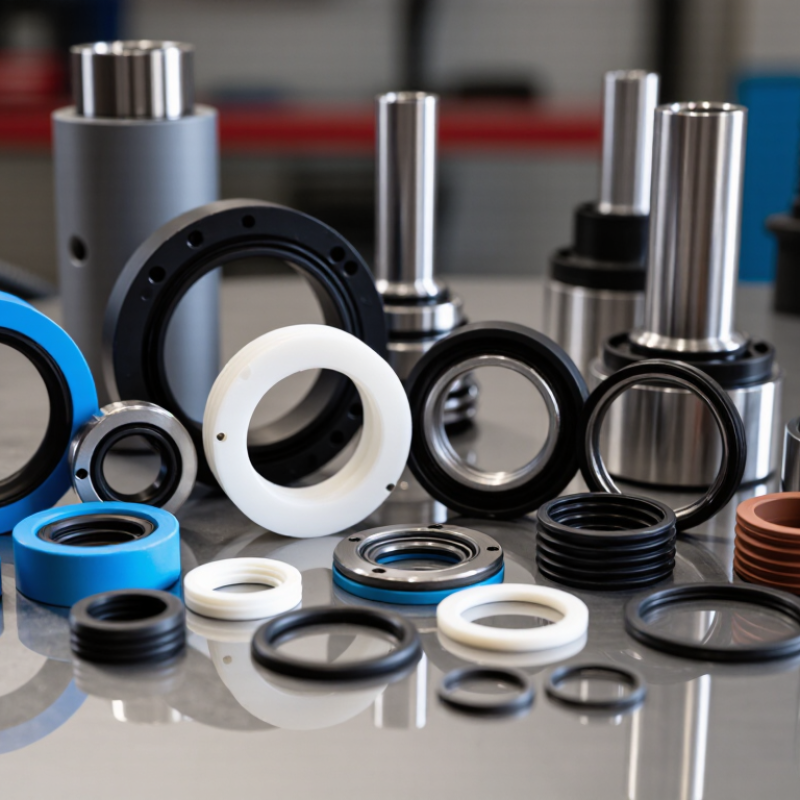
Hydraulic cylinder seals control pressure, guide movement, and prevent fluid from escaping. A piston seal separates both sides of the piston, while a rod seal protects the cylinder from external leakage. Wiper seals remove dust and moisture before they reach the pressure zone. Small parts matter. A damaged guide ring can also create uneven loading, accelerating seal wear.
Operating principles are simple but demanding. Pressure pushes the sealing lip against the metal surface, creating a controlled barrier. Excessive pressure may cause extrusion through the clearance gap. Friction then generates heat, especially during rapid cycling. Polyurethane suits many heavy-duty applications, NBR performs well with common hydraulic fluids, and PTFE reduces friction at higher temperatures. Material selection must match pressure, speed, temperature, fluid chemistry, and surface finish.
The U.S. Department of Energy’s industrial hydraulic guidance indicates that avoidable leakage and related losses can reach 20–30% in poorly maintained systems. A 2024 Grand View Research assessment also places hydraulic equipment growth near 4% annually through the decade, increasing demand for reliable sealing components. In field inspections, technicians should check rod scoring, hardened lips, dust buildup, and unexplained oil films. Replacing a seal without correcting shaft damage is a common mistake. I have seen clean-looking cylinders fail again because clearance measurements were skipped. ISO 5597 provides useful dimensional guidance, but real service conditions still require testing and careful judgment.

Selecting the ten best hydraulic cylinder seals for 2026 starts with duty conditions, not catalog popularity. A 2024 Grand View Research analysis estimated the global hydraulic equipment market at about USD 49 billion in 2023, showing why small sealing losses matter across large fleets. Yet market size does not prove seal quality. Record pressure, rod speed, temperature, fluid type, contamination, and idle time from actual machines. Field notes beat assumptions.
Material selection should follow compatibility charts and test evidence. Polyurethane suits abrasive, high-pressure rod service, while nitrile rubber often fits mineral-oil applications at moderate temperatures. Fluorocarbon rubber handles higher heat, but it can disappoint during cold starts. PTFE reduces friction and tolerates aggressive fluids, though it usually needs energizing or an engineered backup. EPDM suits water-based fluids, not petroleum oils. The 2023 Seals Market report by Freedonia identifies performance life and application compatibility as major purchasing factors. I would still verify the test method; reports compress different duty cycles into one market label.
Design matters as much as chemistry. Compare single- and dual-lip profiles, anti-extrusion rings, scraper geometry, gland fill, and extrusion clearance. Use ISO 5597 dimensions where applicable, then confirm dynamic leakage through representative cycling. Measure breakaway force, steady friction, wear, and leakage after contamination exposure. A seal surviving 10,000 clean-oil cycles may fail beside a dusty quarry rod. That uncomfortable gap deserves attention. Choose pressure and temperature margins, but avoid excessive preload, which can generate heat and accelerate wear.
The 10 Best Hydraulic Cylinder Seals for 2026 should be chosen by working conditions, not popularity alone. A dependable selection includes piston seals, rod seals, wiper seals, guide rings, wear rings, buffer seals, O-rings, backup rings, V-packings, and U-cups. Each design controls a different leakage or wear risk.
Piston seals manage pressure between the piston and cylinder bore. Rod seals protect the hydraulic fluid near the polished rod surface. Wiper seals remove mud, dust, and moisture before they enter the cylinder. Guide rings limit side loading, while wear rings reduce metal contact. Polyurethane suits many abrasive applications. PTFE performs well with low friction and changing temperatures. Nitrile rubber remains practical for common mineral oils.
Small details matter. Measure the groove width, shaft diameter, bore size, and seal clearance before ordering. Check fluid compatibility and operating temperature. A seal that fits loosely may leak within hours. An overly tight seal can generate heat and drag.
Field experience also shows an uncomfortable truth: the “best” seal can fail after poor installation. A scratched rod, sharp groove edge, or dry startup may ruin new components. I would not call this list final. Pressure cycles, contamination, and maintenance habits can change the result. Inspect the old seal for cuts, flattening, swelling, or uneven wear. Those marks often explain more than a catalog description.
Comparison of common hydraulic-cylinder sealing profiles using typical maximum pressure ratings. Actual performance depends on seal material, clearance, fluid, temperature, installation, and cylinder design.
How to read this chart: PTFE-based step seals generally provide high pressure capability and low friction, while polyurethane U-cups and compact seals offer strong wear resistance for general hydraulic applications. V-packings and O-ring configurations remain useful where adjustability, static sealing, or heavy-duty service is required.
Choosing among the 10 best hydraulic cylinder seals for 2026 depends on pressure, temperature, fluid type, and rod speed. A seal that performs well in one cylinder may fail quickly in another. Check the manufacturer’s dimensions, groove design, and material limits before installation.
Clean the cylinder bore, rod, and seal grooves with lint-free materials. Remove metal chips, dried oil, and sharp edges. Lightly lubricate the seal with compatible hydraulic fluid. Never stretch a seal over a sharp thread or force it with a screwdriver. Use a soft installation tool instead. Confirm the sealing lip faces the pressure side. Misalignment is easy to miss, but it often causes early leakage. I have seen careful repairs fail because the rod was not inspected for scoring.
Tips: Keep it clean. Measure twice. Replace damaged backup rings and worn wipers at the same time. During maintenance, inspect leakage patterns, rod marks, unusual heat, and slow movement. A film of oil may be normal, while a steady drip indicates a problem. If leakage continues, check rod alignment, excessive pressure, contaminated fluid, and incorrect seal compression. Do not tighten fittings blindly. That may hide the symptom and damage threads. Record operating conditions after repair, including pressure, temperature, and cycle frequency. This simple record can reveal a pattern that memory misses.
10 Best Hydraulic Cylinder Seals for 2026?
Safety, Compatibility, and Future Trends in Hydraulic Sealing
Choosing the ten best hydraulic cylinder seals requires more than comparing prices. In field maintenance, I check pressure, temperature, rod speed, fluid type, and contamination risks first. Rod seals control external leakage, while piston seals protect internal pressure balance. Wipers remove dust before it reaches sensitive sealing surfaces. Buffer seals can reduce pressure spikes and extend rod seal life.
Safety begins with correct sizing and installation. A seal that looks suitable may fail inside a scored groove or misaligned cylinder. I inspect the rod with a light and fingernail test. Even a small scratch can cut a new seal. Compatibility matters too. Polyurethane often handles abrasion well, while certain elastomers perform better with heat or specialized fluids. Always confirm chemical resistance with technical data and controlled testing. Guessing is expensive.
Future sealing systems will use smarter monitoring. Embedded sensors may track pressure changes, temperature, and leakage before failure occurs. Low-friction materials could reduce energy loss in mobile equipment. Recycled or lower-impact compounds may also become more common, although durability data remains incomplete. This is where my judgment stays cautious. New materials can look impressive in laboratory tests but behave differently after months of dust, vibration, and cold starts. A reliable choice combines verified test results, trained installation, and scheduled inspection records. Perfect selection is rarely possible. Careful revision is.
A practical comparison of commonly used hydraulic cylinder seal profiles and materials. Performance figures are typical engineering ranges and should be verified against the equipment manufacturer’s specifications.
| Rank | Seal profile and material | Typical cylinder position | Typical pressure range | Typical temperature range | Fluid compatibility | Main advantages | Key limitations and safety checks | 2026 selection outlook |
|---|---|---|---|---|---|---|---|---|
| 1 | Polyurethane U-cup rod seal | Rod sealing groove | Up to about 400 bar, design-dependent | Approximately −30°C to +100°C | Mineral hydraulic oils and many water-glycol fluids; confirm formulation compatibility | High abrasion resistance, good extrusion resistance, effective dynamic sealing | Can be damaged by excessive heat, sharp installation edges, or incompatible fluids; use back-up support where required | A strong general-purpose choice, with increasing demand for low-friction and lower-emission formulations |
| 2 | PTFE step seal with elastomer energizer | Rod or piston groove | Often 250–500 bar with suitable anti-extrusion design | Approximately −50°C to +200°C, material-dependent | Broad chemical resistance; suitable for many mineral oils, water-based fluids, and synthetic fluids | Very low friction, high temperature capability, and good resistance to chemical attack | Requires accurate groove dimensions and controlled surface finish; may need a dynamic energizer to seal at low pressure | Well suited to electrified, high-efficiency systems where reduced friction and extended service intervals matter |
| 3 | Nitrile rubber rod seal | Rod sealing groove | Commonly up to 250–350 bar, profile-dependent | Approximately −30°C to +100°C | Good compatibility with petroleum-based hydraulic oils | Cost-effective, widely available, and easy to install in standard applications | Limited resistance to ozone, weathering, phosphate-esters, and some water-based fluids; avoid overheating | Remains practical for conventional oil systems when environmental exposure and fluid chemistry are controlled |
| 4 | Hydrogenated nitrile rubber piston seal | Piston groove | Typically up to 350–450 bar, profile-dependent | Approximately −30°C to +150°C | Mineral oils and many demanding hydraulic fluids; verify additives and temperature limits | Better heat, oxidation, ozone, and wear resistance than standard nitrile rubber | Not universally compatible with every ester, solvent, or fire-resistant fluid; extrusion gaps must be controlled | A balanced option for mobile and industrial cylinders exposed to vibration, heat, and outdoor conditions |
| 5 | Fluorocarbon rubber seal | Rod, piston, or static sealing location | Often up to 300–400 bar, profile-dependent | Approximately −20°C to +200°C | Many mineral oils, fuels, and high-temperature synthetic fluids | Excellent heat, oxidation, and chemical resistance | Poor choice for hot steam, some amines, and certain low-temperature applications; relatively high material cost | Useful for high-temperature or chemically aggressive environments, provided low-temperature flexibility is adequate |
| 6 | EPDM seal | Static, rod, or piston sealing location | Usually up to 200–300 bar, profile-dependent | Approximately −50°C to +150°C | Water, water-glycol, phosphate-ester fluids, and weather-exposed service | Excellent resistance to water, ozone, weathering, and many fire-resistant fluids | Generally incompatible with petroleum-based mineral oils; incorrect fluid selection can cause rapid swelling or failure | Important for water-based and fire-resistant hydraulic systems where oil-resistant elastomers are unsuitable |
| 7 | Bronze-filled PTFE piston seal | Piston sealing groove | Commonly 250–500 bar with proper back-up design | Approximately −50°C to +150°C | Many mineral oils and selected water-based or synthetic fluids | High wear resistance, low friction, and improved dimensional stability over unfilled PTFE | May be unsuitable for some chemically sensitive fluids; requires compatible mating surfaces and correct energizer selection | A strong candidate for high-cycle cylinders requiring low friction and stable performance under heavy loads |
| 8 | Polyurethane wiper seal | External rod wiper groove | Normally a contaminant barrier rather than a pressure seal | Approximately −30°C to +100°C | Compatible with many mineral-oil environments; fluid exposure should be checked | Keeps dirt, water, and debris out; protects internal rod and gland seals | Cannot replace a pressure-rated rod seal; excessive interference or poor lubrication can increase rod friction | Increasingly important in dusty, wet, recycled-water, and autonomous-equipment applications that require contamination control |
| 9 | Polyurethane or PTFE guide ring | Rod and piston guidance groove | Not a primary pressure seal; supports side-load management | Approximately −50°C to +120°C, material-dependent | Selected according to the hydraulic fluid, load, and temperature | Reduces metal-to-metal contact, protects sealing surfaces, and handles radial loads | Must be sized for clearance and load; it does not provide fluid containment by itself | Essential for longer seal life as cylinders become lighter, more compact, and exposed to higher side loads |
| 10 | Metal-scraper reinforced wiper | External rod wiper groove | Contaminant barrier; not intended as the main pressure seal | Approximately −30°C to +100°C, material-dependent | Choose the elastomer according to the hydraulic fluid and outdoor exposure | Improves protection against compacted mud, ice, scale, and coarse particles | Poor alignment or damaged rod surfaces can wear the scraper and generate particles; confirm housing and rod clearances | A useful safety-focused option for construction, agricultural, forestry, and other severe-contamination environments |
Selection and safety note
Actual limits depend on seal geometry, pressure peaks, extrusion gap, speed, surface finish, fluid additives, installation method, and cylinder design. Depressurize and mechanically support the cylinder before inspection or seal replacement. Never select an elastomer solely by temperature or pressure; verify chemical compatibility and the complete operating cycle.


For those larger-sized parts, or smaller quantity runs, we have 2 independent powder coat booths and ovens. The quality, durability and affordability of today’s powder coating finishes make this the process of choice for world-class companies.
Powder coating advantages over other forms of coating are many. Materials used in the Powder coating process can be metals and non-metals that come in a multitude of thicknesses, textures, colors, etc. Another of Powder coating’s biggest advantages over conventional coatings is its ability to create finishes in many different textures. Powder Coating Booths allow us the ability to apply these advantages to large products.
Tri-State Fabricators runs a full-service conveyor line for painting. Wet painting can provide protection or decoration to many different part styles. From start to finish, every project is easier to undergo random and point-based inspection by our skilled painting team.
Advantages to our Wet Paint Line are these lines start with product prep and ends with a thorough inspection of a high quality finished product. Our ability to complete large and small projects with a superior finish and doing so in a timely and economical fashion. This passes along the savings in production to our customers. When powder coating ins not an option, our Wet Paint Line gets the job done right the first time.
When the parts get big and heavy we roll-out our custom paint racks and oversize booth. By utilizing our partnerships with all the major paint brands, we can match virtually any color with wet paint.
The advantages of having access to a Wet Paint Booth are many. Large projects of many different shapes can be loaded into the booth. The Wet Paint Booth offers an environment that is much more controlled than a typical parts painting operation.
Not only are they used because of their controlled environment, but they’re are also advantageous when it comes to applying paint to parts that are needed in industries that require specialty coatings such as medical, aerospace, etc.
Our military forces have some very high standards when it comes to the finish of their vehicles and equipment. From the first pre-treatment step to final coat, it takes a great deal of knowledge and experience to protect the men and women of our armed forces. They deserve only the best, and Tri-State Fabricators provides it.
All of our processes are closely monitored by our staff and management teams. Both of which are highly trained in the processes of metal fabrication and finishing. Tri-State Fabricators’ goal is to always fully satisfy each and every customer, including the military. We will always put a 110% into what we do.
Abrasive media blasting is an excellent way to remove old paint, rust, and increase the paint/powder adhesion. Glass beads produce a much smoother and brighter finish than angular abrasives; leaving the part clean yet without any dimensional change. Chemically inert and environmentally friendly, we can recycle our beads approximately 30 times; making them a more preferred method of metal cleaning or surface finishing.
Advantages to Glass Bead Blasting are many. Glass bead blast media is used when a project is needing rough surfaces need to become smooth for applications of coatings such as paint. It is typically used to clean paint and rust from a product surface without deforming the surface it is being used on. Overall, compared to many other blasting media, Glass Bead Blasting is a very economical choice and those savings are always passed on to our customers.
Tri-State Fabricators utilize a zinc phosphate wash to clean and etch the material to ensure the best paint adhesion possible. The unique design of our 3-stage wash system does the work like a 5-stage. From Cleaning and rinsing to conversion coating and post-treatment, Our Part Washing process is a complete service and works throughout the fabrication service and the finishing service.
Along with the previously mentioned benefits, Curing is a vital chemical reaction that leaves the product finish hard and relatively safe from mild abrasion and aggressive corrosion. This process can be done in more than one way; ambient air-dry or in curing ovens at temps that exceed 240°.
From fixing paint mistakes (someone else’s of course) to simply cleaning our paint line hooks, our burn-off oven is put to good use. After a quick burn-off, a little clean up, and a fresh coat of paint, your parts will look better than new.
Why does our Burn-Off Oven work so well? Because super heating the air around parts turns the materials into ashes. From paint and powder coatings to rubber and machining oils, high temps do the job without degrading the integrity of the part.
Masking is a vital part of producing high quality products. We have die-cut masking patterns to protect machined surfaces as well as a wide range of plugs and caps to protect threaded holes and bolts. We provide permanent and temporary masking.
Masking allows the selected sections of a product to be protected from a fabrication or finishing service. This can be with both chemicals when etching and tapes, paints when only finishing just a section of the product. Masking is great in aiding the customization process of a project.
Screen printing is a photographic process that transfers artwork onto a porous nylon screen which allows colored ink to flow through the screen and be deposited on an aluminum or plastic component. We can generally have just about any design created onto a screen for your parts.
Some of the advantages of Screen Printing are, brand recognition for your business displaying on your products, assembly instructions, product warnings/hazards, etc. Tri-State Fabricators produces Screen Printing of the highest quality so you know it’s durable.
Metal Finishing is the art of treating the exterior portion of product, often metal but can also be made of other materials, so that the surface is clean and free of any debris. Then the process of applying coats or either paint of powder coat takes place. This coating process improves the quality of the product in both appearance and resistance to wear and corrosion.
Tri-State Fabricators, Inc., understands that a project typically isn’t complete until a high-quality finish has been added to your product. This is why our painting and powder coating teams continuously inspect the products throughout the Metal Finishing process.

